
Most garage door opener issues don’t start as failures.
They start as small changes.
A slight delay when you press the remote. A door that pauses for a second before moving. A sound that feels a bit different than usual. Nothing dramatic at first.
Then one day, it doesn’t respond at all.
For homeowners, especially in busy routines, that moment always feels sudden. You are ready to leave, or just getting home, and the garage door simply doesn’t cooperate.
In most cases, this situation is not about a complete breakdown. It is usually a small fault in power, sensors, remote communication, or mechanical resistance.
Understanding these patterns helps you respond faster.
Book a prompt garage door opener repair service, and avoid unnecessary stress.
Let’s get started!
1. When the Garage Door Stops Responding:
This is the most common issue homeowners face. You press the remote, and nothing happens. No movement. No sound.
Before assuming the opener has failed, it is important to slow down and check a few basic things.
Often, the issue is not the motor itself.
Start with power. Garage door openers are surprisingly sensitive to something as simple as a tripped breaker or a loose plug. After that, check whether the wall button works. If it does, the problem usually sits in the remote or signal system.
Remote batteries are another frequent cause. They weaken slowly, which is why the problem often feels sudden even though it isn’t.
In some cases, the opener simply loses its programming after a power fluctuation. Re-syncing the remote with the opener often restores normal function.
2. When the Door Starts but Doesn’t Move Smoothly:
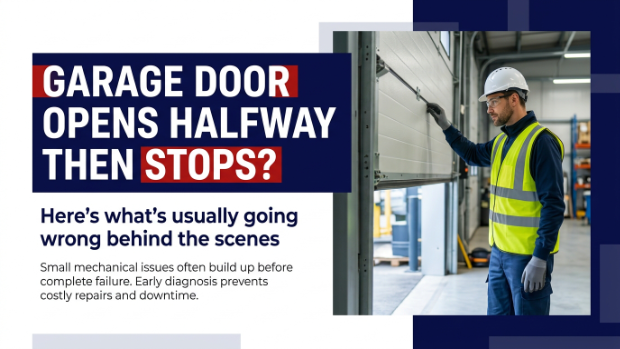
Sometimes the opener responds, but the door behaves differently. It may move slowly, hesitate, or stop halfway.
This usually indicates resistance somewhere in the system.
Garage doors rely on balance. If the door itself is heavier on one side or there is friction in the tracks, the opener struggles to complete the movement. Over time, this creates extra pressure on the motor.
Even small issues like dry rollers or slight track misalignment can affect movement.
A quick inspection of the door’s physical path often reveals whether the issue is mechanical rather than electronic.
If the door feels heavy when manually lifted, the opener is likely compensating for a deeper mechanical issue.
3. When the Remote Works Intermittently
Intermittent operation is one of the most frustrating problems because it feels unpredictable.
One moment, everything works normally. Next, nothing happens.
In many cases, this comes down to weak signal strength or interference. Modern homes have many devices that operate on similar frequencies, which can affect garage door communication.
LED lighting, for example, can sometimes interfere with older opener systems. Even the position of the antenna on the motor unit can affect range and reliability.
There are also situations where the remote itself is wearing out internally. Buttons become less responsive, or internal contacts weaken over time.
When the problem is inconsistent, it is usually not a full system failure. It is a signal or connection issue that is gradually getting worse.
You can book a top-notch garage door opener repair service from a reliable provider to avoid this and further situations.
4. When the Garage Door Reverses Before Closing
This is a built-in safety response.
Garage door systems are designed to reverse when they detect resistance or obstruction. But when it happens frequently, even without anything blocking the door, something is wrong.
In many cases, the safety sensors near the bottom of the door are misaligned or slightly dirty. Even a small shift can interrupt the signal between them.
Sunlight can also interfere in certain positions, causing the system to misread the path as blocked.
Another possible reason is incorrect sensitivity settings on the opener itself. If the force setting is too low, the system reacts too quickly and reverses unnecessarily.
While this issue is often simple, it should not be ignored because it directly affects safety and reliability.
5. When the Opener Runs but the Door Stays Still:
This situation usually points to a mechanical disconnect.
You hear the motor working, but the door does not move.
In many cases, the drive mechanism inside the opener is worn or disengaged. The chain, belt, or internal gear system may not be transferring force properly.
Sometimes the emergency release has been triggered accidentally, disconnecting the door from the opener system.
When this happens, the motor is technically working, but it is no longer connected to the door itself.
This type of issue is usually not something to force or repeatedly test, because it can increase wear on internal components.
Why These Problems Should Not Be Ignored:
Garage door opener issues tend to escalate gradually.
What starts as a delay or small inconsistency often leads to complete failure if ignored.
A struggling opener puts extra load on the entire garage system. Springs, tracks, rollers, and cables all end up compensating for that strain.
Over time, this can turn a simple adjustment into a much larger repair.
There is also the safety aspect. A malfunctioning opener can behave unpredictably, especially when sensors are not working correctly.
That is why early attention matters more than most homeowners realize.
A Note on Professional Repair Support
While some small checks can be done safely at home, not every issue should be handled manually.
If the problem involves internal motor components, electrical faults, or repeated failure after basic troubleshooting, it is better to have the system inspected by a professional.
A trained technician can quickly identify whether the issue is:
- electrical.
- mechanical.
- sensor-related.
- or a combination of multiple factors.
This saves time and prevents unnecessary trial and error.
For homeowners dealing with persistent issues, Adams Garage Doors LLC provides professional garage door opener repair services, diagnostics, and system support to restore safe and reliable operation. With a team of expert professionals, we can fix any of your garage door problems in no time!
FAQ:
What is the most common garage door repair?
The most common repair is fixing broken springs or sensor misalignment issues. These problems stop the door from opening or closing properly.
Is repairing a garage door opener better than replacing it?
Repair is usually better if the opener is under 10–12 years old and the issue is minor. If it keeps breaking or is outdated, replacement is more cost-effective long-term.
Can I replace a garage door opener myself?
It is possible for experienced DIY users, but it involves electrical wiring and heavy lifting. Most homeowners prefer professional installation for safety and proper setup.
Why is my garage door opener not working?
It often stops working due to power issues, dead remote batteries, or misaligned sensors. In some cases, it can also be a motor or internal gear problem.
Final Thought:
Garage door opener problems rarely appear without warning.
They usually begin quietly. A small hesitation. A sound that feels slightly different. A response that takes just a bit longer than usual.
Most people only notice the problem when the system finally stops working.
But in reality, the system was already showing signs.
Recognizing those early signals is what helps prevent sudden breakdowns and keeps your daily routine running smoothly.
To get a fast garage door opener repair service, call Adams Garage Doors LLC today!