
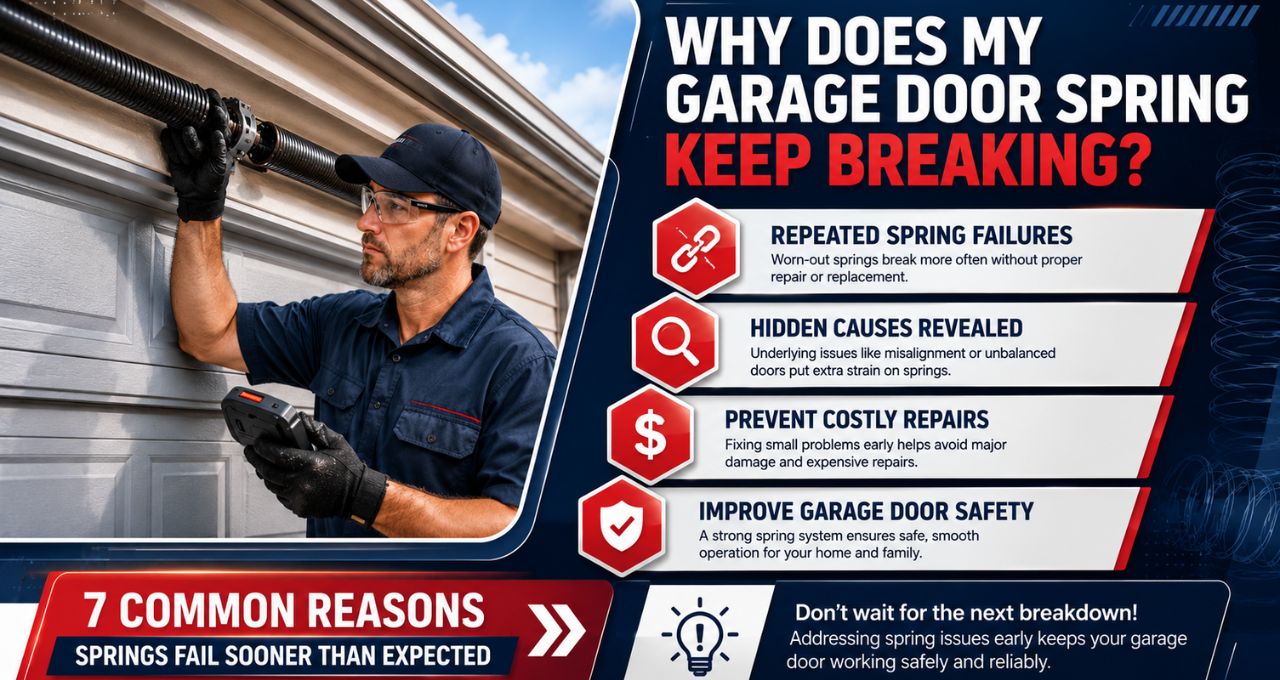
The first time a garage door spring breaks, most homeowners think it was just bad luck.
The second time, it becomes frustrating.
The third time, it becomes expensive.
At that point, the question changes. Instead of asking, “How do I fix this?” homeowners start asking, “Why does this keep happening?”
It’s a fair question.
A garage door spring is designed to handle thousands of opening and closing cycles. Yet some springs fail after only a few years, while others continue working for well over a decade. The difference often has less to do with luck and more to do with factors that most homeowners never see.
If you’ve dealt with a broken garage spring more than once, there is usually an underlying reason. Understanding that reason can help you avoid repeat repairs, improve safety, and extend the life of your entire garage door system.
What Does a Garage Door Spring Actually Do?
Before discussing why springs fail, it helps to understand their role.
Many people assume the garage door opener does most of the lifting. In reality, the springs do most of the heavy work.
Garage door springs store and release energy to counterbalance the weight of the door. Without properly functioning springs, even a standard residential garage door would feel extremely heavy to lift.
Every time the door opens and closes, the springs stretch, unwind, rewind, and absorb stress. Over time, that constant movement takes a toll.
Why Does Your Garage Door Spring Keep Breaking?
If the same problem keeps happening, one of these seven reasons is often responsible.
1.Every Opening and Closing Uses Up Spring Life:
This is the most common cause of spring failure.
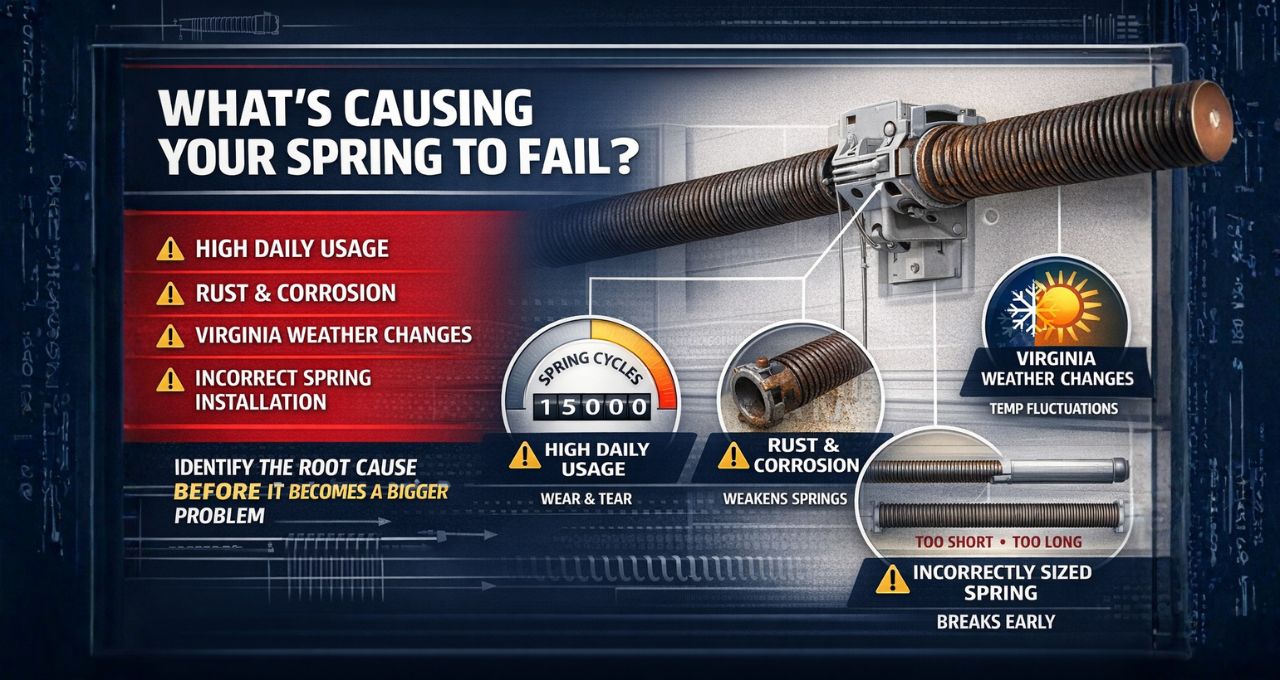
Garage door springs are rated by cycles. One cycle equals one complete opening and closing of the door.
Most standard springs are designed for approximately 10,000 cycles. Depending on how often the door is used, that lifespan can vary significantly. A busy household that uses the garage as the main entrance may reach that limit much sooner than expected.
Think about your daily routine.
- Leaving for work.
- Returning home.
- School runs.
- Weekend errands.
- Each trip adds more wear to the spring.
If your family uses the garage door multiple times a day, the spring may simply be reaching the end of its designed lifespan faster than you realize.
2.Rust Is Slowly Destroying the Metal:
Rust may seem like a cosmetic problem, but it can dramatically shorten spring life.
When moisture reaches the steel, corrosion begins forming on the coils. As rust develops, friction increases whenever the spring moves. That additional friction creates extra stress, causing the spring to weaken more quickly.
Many Virginia homeowners don’t notice the damage until the spring finally snaps.
The frustrating part?
A small amount of preventive maintenance can often slow this process significantly.
Regular lubrication helps reduce friction and protects the metal from moisture exposure.
3.Virginia Weather Creates Extra Stress:
Virginia weather can be surprisingly tough on garage door systems.
One week may bring freezing temperatures. The next may feel like spring.
Those constant temperature changes affect metal components. As temperatures rise and fall, the steel inside the spring expands and contracts. Over time, this repeated stress contributes to fatigue and wear.
Cold mornings are particularly challenging.
Many technicians report seeing spring failures during colder months because metal becomes less flexible when temperatures drop. Existing weaknesses in the spring become more likely to turn into full breaks.
This is one reason why homeowners throughout Virginia often experience unexpected spring failures during seasonal transitions.
4.The Wrong Spring Was Installed:
Not all garage door springs are the same.
Every garage door requires a spring designed for its specific weight, size, and operating requirements.
When an incorrectly sized spring is installed, problems begin immediately.
A spring that is too weak works harder than it should. A spring that is too strong creates imbalance throughout the system. In either case, excessive stress shortens lifespan and increases the likelihood of future failure.
Unfortunately, this is a common reason homeowners experience repeated spring problems after a previous repair, and that leads to garage door spring replacements.
Proper sizing matters more than many people realize.
5.Only One Spring Was Replaced:
This is another issue that often leads to recurring repairs.
Many double garage doors use two springs.
When one spring breaks, homeowners sometimes replace only the damaged spring in an effort to save money.
The problem is that the second spring has usually experienced the same amount of wear.
Imagine replacing one worn tire on a vehicle while leaving the other three untouched. The system becomes uneven.
The same principle applies to garage doors.
When one older spring continues operating alongside a new spring, imbalance develops. This can place additional strain on the remaining spring and increase the chances of another failure.
- Lack of Maintenance Is Accelerating Wear
Garage doors are often overlooked until something goes wrong.
That’s understandable. When a system works every day, it’s easy to assume everything is fine.
However, routine maintenance plays a major role in spring lifespan.
Simple maintenance tasks include:
- Lubricating springs and moving parts.
- Tightening loose hardware.
- Inspecting cables.
- Checking door balance.
- Scheduling professional inspections.
These small steps help reduce unnecessary stress throughout the system and allow potential problems to be identified before they become expensive repairs.
A little maintenance today can prevent a major breakdown tomorrow.
7.The Entire System Is Working Too Hard:
Sometimes spring isn’t the real problem.
Sometimes the entire garage door system is placing extra stress on the spring.
For example:
- Worn rollers create resistance.
- Bent tracks affect movement.
- Damaged hinges increase strain.
- Heavy insulated doors require more lifting force.
- Aging openers may contribute to imbalance.
When the door doesn’t move smoothly, the spring must compensate.
Over time, that additional workload accelerates wear and increases the likelihood of failure.
This is why professional inspections often focus on the entire system rather than just the spring itself.
How Long Should a Garage Door Spring Last?
Most standard garage door springs are designed for approximately 10,000 cycles, which often translates to about 7 to 10 years for the average homeowner. However, lifespan depends heavily on usage frequency, maintenance, climate conditions, spring quality, and proper installation. High-cycle springs can last significantly longer when matched correctly to the door.
The simple truth is that there is no universal expiration date.
Two identical homes can have dramatically different spring lifespans based on how frequently the garage door is used.
How Can You Prevent Future Spring Failures?
While no spring lasts forever, there are several ways to maximize its lifespan.
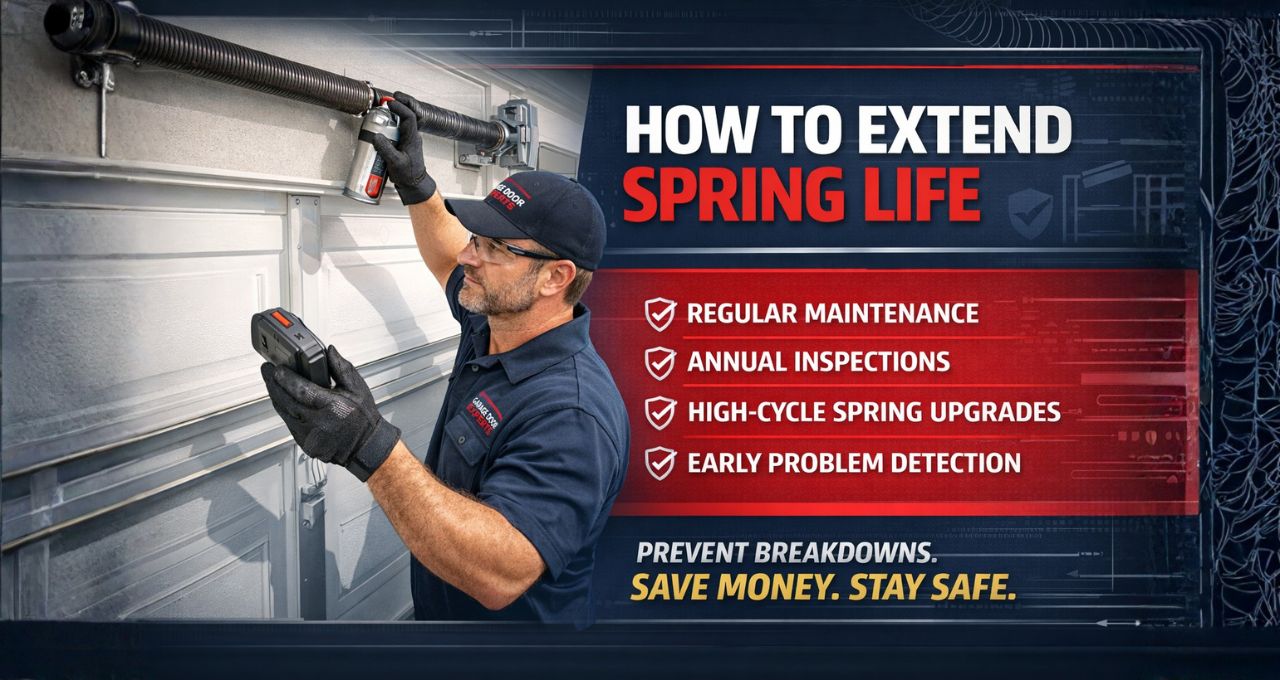
- Preventive Maintenance Checklist.
- Lubricate springs regularly.
- Schedule annual garage door inspections.
- Replace worn rollers promptly.
- Keep tracks clean
- Address unusual noises immediately.
- Ensure springs are correctly sized.
- Replace both springs when recommended.
- Upgrade to high-cycle springs if your household uses the garage frequently
These steps won’t eliminate wear entirely, but they can help reduce unnecessary stress on the system.
When Is Garage Door Spring Replacement the Better Option?
Sometimes repairs are no longer the most practical solution.
If the spring has reached the end of its cycle life, replacement is usually the safest and most cost-effective choice.
Repeated repairs on an aging spring often lead to additional expenses without solving the underlying problem.
If your garage door is showing signs of spring fatigue, unusual noises, imbalance, or difficulty opening, professional garage door spring replacement may be the best long-term solution.
If you’ve experienced a sudden spring failure before, be sure to review our guide on emergency situations caused by damaged garage door springs.
You may also find it helpful to read our breakdown of average spring replacement costs and repair options in 2026 when planning future repairs.
What Sets Adams Garage Doors LLC Apart?
When a spring breaks, homeowners need more than a quick fix. They need a solution that prevents the problem from happening again.
Adams Garage Doors LLC helps homeowners throughout Virginia identify the true cause of recurring spring failures rather than simply replacing parts and hoping for the best.
We are trusted by several homeowners because we offer:
- Professional garage door spring replacement.
- Accurate spring sizing and balancing.
- Emergency repair services.
- Experienced technicians.
- Honest recommendations.
- High-quality replacement components.
- Local Virginia expertise.
- Fast response times.
Most importantly, their team focuses on restoring the safety, reliability, and long-term performance of your garage door system.
Frequently Asked Questions:
Why does my garage door spring keep breaking?
Repeated spring failures are often caused by high usage, rust, incorrect spring sizing, poor maintenance, or system imbalance. A professional inspection can identify the root cause.
How long should garage door springs last?
Most standard springs last around 10,000 cycles, which often equals 7 to 10 years for the average household. Higher-cycle springs may last considerably longer.
Should both garage door springs be replaced at the same time?
In many cases, yes. If one spring has failed, the second spring has often experienced similar wear and may fail soon afterward.
Can cold weather break a garage door spring?
Cold temperatures can make steel less flexible and increase stress on already worn springs, making winter a common time for failures.
Can I replace a garage door spring myself?
Garage door springs operate under extreme tension and can cause serious injuries if handled improperly. Professional replacement is strongly recommended.
Final Thoughts :
A garage door spring rarely breaks without a reason.
Sometimes it’s age. Sometimes it’s the weather. Sometimes it’s an incorrectly sized spring or a system that has been working harder than it should for years.The good news is that many repeat failures can be prevented once the real cause is identified.
If you’re dealing with a broken garage door spring or want to avoid another unexpected failure, addressing the problem early can save money, improve safety, and help your garage door operate reliably for years to come.
Need Garage Door Help? Get in Touch with Us!