
A garage door that suddenly stops working does not always mean you need an expensive repair. Before calling a technician, homeowners can safely check the remote battery, opener power, safety sensors, visible obstructions, and other simple issues.
However, broken springs, damaged cables, off-track doors, severe track damage, and high-tension components should never become DIY projects. Knowing what to check, and when to stop, can save both money and trouble.
Before You Spend Money, Run This 5-Minute Check
When a garage door refuses to open or close, it is tempting to assume the worst.
Don’t.
Start with the basics.
Try the wall-mounted control. Then try the remote. Listen to the opener. Look at the sensors. Check whether anything is blocking the door.
These simple observations can tell you whether you are dealing with a minor issue or a problem that needs professional and affordable garage door repair.
| What you notice |
Safe first check |
When to stop |
|
Remote does not work |
Replace the battery |
Call for help if it still fails |
|
Opener is silent |
Check power and breaker |
If power is available but opener stays dead |
|
Door will not close |
Check safety sensors |
If sensors are damaged or remain faulty |
| Door moves unevenly | Look for obvious obstruction |
Do not force the door |
|
Door is unusually heavy |
Stop operating it | Call a technician |
|
Loud bang or snap |
Inspect only from a safe distance |
Do not touch springs or cables |
| Cable is loose or frayed | Leave it alone |
Professional repair is needed |
|
Door is off track |
Keep people away from it |
Call a technician |
That last column matters more than the first one.
A few minutes of troubleshooting can save you an unnecessary service call. But trying to save money by repairing a high-tension component yourself can turn a relatively straightforward repair into a serious safety problem.
What Can You Safely Check Yourself?
Not every garage door problem requires a toolbox.
In fact, several basic checks can be done without dismantling the system.
1. Check the Remote Battery:
This is the easiest place to start.
If the wall control opens the door but the remote does not, replace the remote battery and test it again.
If you have a second remote, try that one too.
This small test can quickly tell you whether the problem is with the garage door opener or simply the remote.
2. Check Whether the Opener Has Power:
If nothing happens when you press the wall control, check the obvious things first.
Is the opener plugged in?
Has a breaker tripped?
Is there power elsewhere in the garage?
If the garage has lost power, the opener may be perfectly fine.
However, do not open the motor housing or start working on electrical components yourself. If the opener has power but remains unresponsive, professional troubleshooting is the safer choice.
3. Look at the Safety Sensors:
Garage door safety sensors sit close to the floor on either side of the opening.
They need a clear line of sight.
Dust, cobwebs, dirt, or an object placed directly in front of a sensor can prevent the door from closing properly.
You can gently clean the sensor lenses with a soft cloth and check whether anything is blocking them.
Do not bend, force, or dismantle the sensor brackets.
4. Check for Visible Obstructions:
Take a slow look at the garage door’s path.
A storage box, tool, piece of debris, or another object can sometimes interfere with movement.
If there is loose debris that you can safely remove, clear it away.
But don’t confuse an obstruction with a damaged track.
A bent or severely misaligned track is not a simple DIY adjustment.
What Garage Door Problems Should You Never Try to Repair Yourself?
This is where affordable garage door repair advice needs a safety boundary.
Some garage door components are under significant tension.
Springs are the biggest example.
If a spring breaks, the door can suddenly become extremely heavy because the mechanism is no longer properly counterbalancing the door. Adams Garage Doors LLC notes that broken springs can create serious problems and recommends professional repair rather than DIY handling.
Do not attempt to:
- Replace or adjust torsion springs.
- Rewind a garage door spring.
- Repair high-tension spring hardware.
- Replace lifting cables.
- Force an off-track door back into position.
- Straighten a severely bent track.
- Work on damaged drums.
- Continue using a visibly unstable door.
If you hear a loud snap and the door suddenly becomes difficult to lift, stop.
That is a technician situation, not a weekend project.
Could a Strange Noise Be an Early Warning?
Yes.
Your garage door may give you plenty of warning before a major breakdown.
The problem is that homeowners often get used to the noise.
A little squeaking becomes normal. A slight grinding sound gets ignored. The door shakes a little more than it used to, but it still opens, so life continues.
That can be a mistake.
Adams Garage Doors LLC identifies different garage door noises, including squeaking and grinding, as potential signs of wear involving rollers, hinges, tracks, or other components.
If your garage door has started making a sound it never made before, pay attention.
For a deeper look at the warning signs, read this
The goal is not to panic over every squeak. It is to notice when your door’s behaviour has changed.
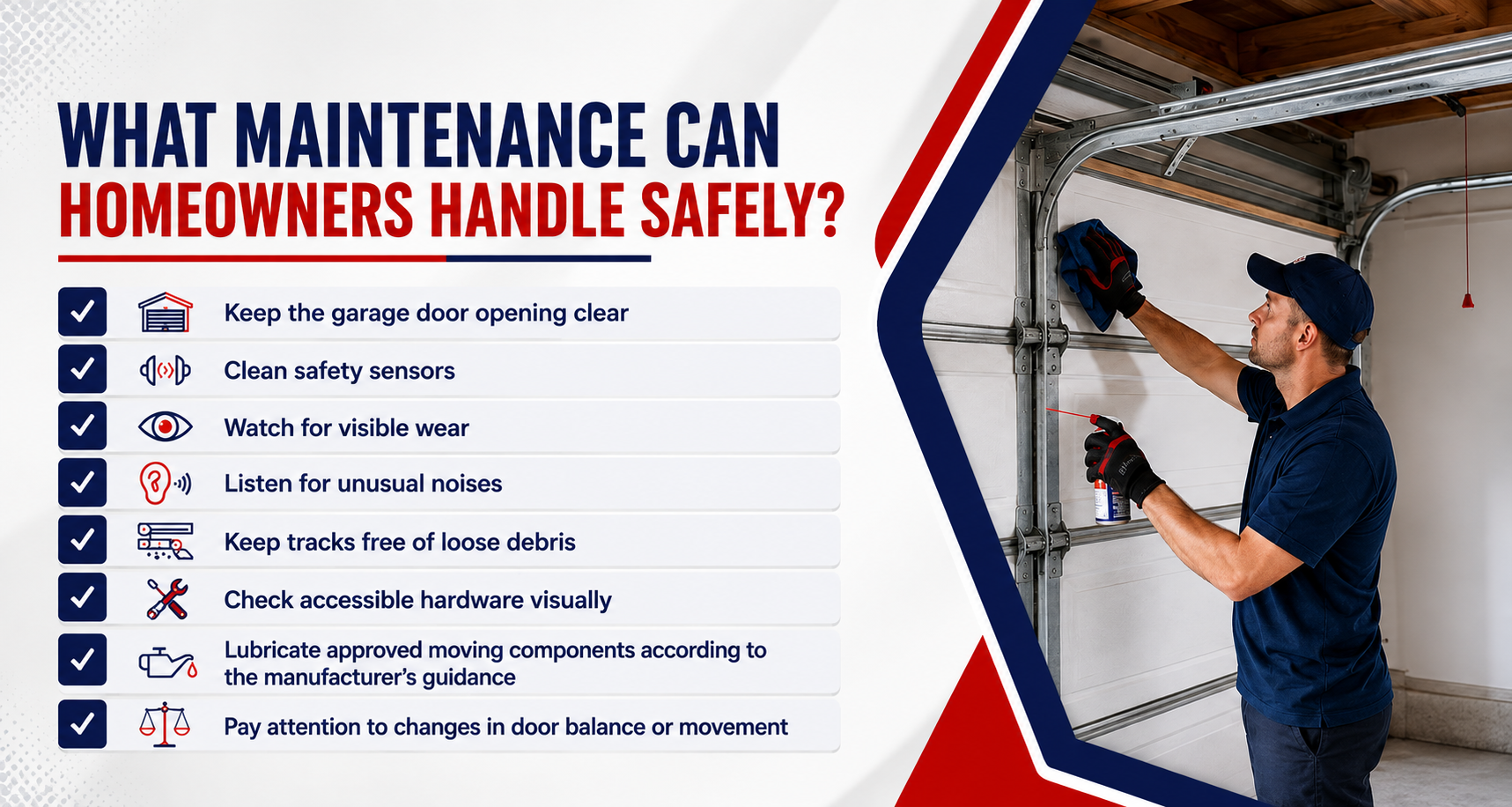
What Maintenance Can Homeowners Handle Safely?
Some routine maintenance is perfectly reasonable for homeowners.
You can:
- Keep the garage door opening clear
- Clean safety sensors
- Watch for visible wear
- Listen for unusual noises
- Keep tracks free of loose debris
- Check accessible hardware visually
- Lubricate approved moving components according to the manufacturer’s guidance
- Pay attention to changes in door balance or movement
For more practical guidance, see our guide
The important word is safely.
Maintenance does not mean dismantling the door.
If a task requires you to release spring tension, disconnect lifting cables, remove major components, or work around stored mechanical energy, leave it to a trained technician.
Is Your Garage Door Problem Minor or Serious?
Here’s a simple way to think about it.
Green: You can troubleshoot it
These are generally low-risk checks:
- Remote battery.
- Obvious power issue.
- Dirty sensor.
- Object blocking the door.
- Loose debris around the opening.
Yellow: Watch it and arrange an inspection
These signs deserve attention:
- Increasing squeaking.
- Occasional grinding.
- Slower operation.
- Slightly uneven movement.
- Opener sounding different.
- Door taking longer to open or close.
Red: Stop using the door
These situations need professional attention:
- Broken spring.
- Loose or frayed cable.
- Door off its track.
- Door suddenly becomes very heavy.
- Loud bang followed by failure.
- Door drops or moves unpredictably.
- Severe track damage.
- Visible structural damage.
This simple traffic-light approach can prevent a common mistake: treating every garage door problem as either “nothing” or “complete replacement.”
There is usually a middle ground.
Should You Repair or Replace the Garage Door?
A malfunction does not automatically mean you need a new garage door.
A repair may make sense when the door itself is structurally sound and the issue involves an individual component.
Replacement may become more sensible when the door is severely damaged, repeatedly failing, outdated, or approaching the end of its useful service life.
Adams Garage Doors LLC also notes that factors such as system age, component condition, safety concerns, repair costs, and long-term reliability can influence the repair-versus-replacement decision.
So don’t make the decision based solely on one broken component.
Look at the condition of the entire system.
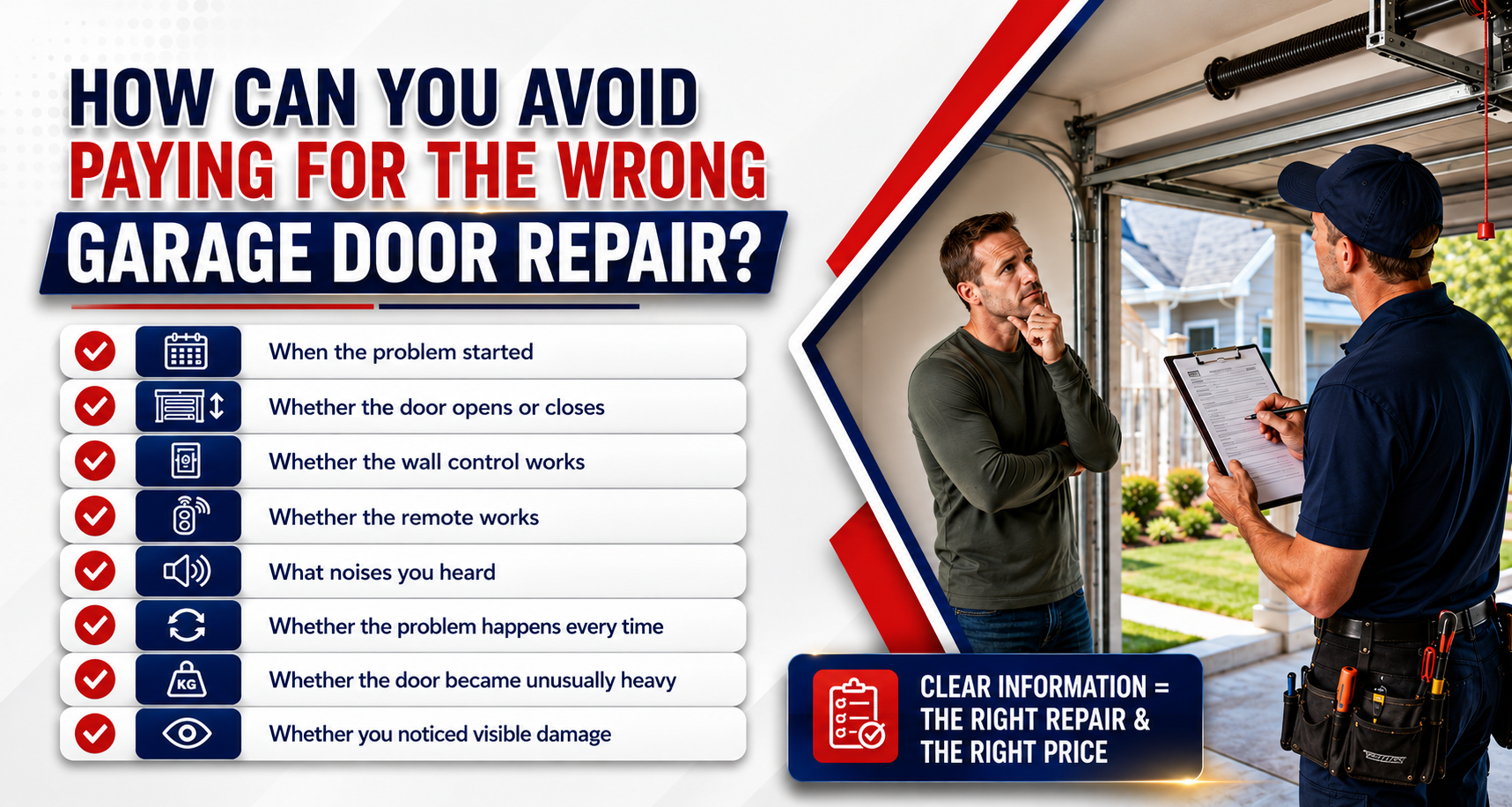
How Can You Avoid Paying for the Wrong Garage Door Repair?
This is an overlooked part of saving money.
Before a technician arrives, write down exactly what happened.
For example:
“The remote stopped working yesterday, but the wall button still opens the door.”
That’s much more useful than:
“My garage door is broken.”
Tell the technician:
- When the problem started.
- Whether the door opens or closes.
- Whether the wall control works.
- Whether the remote works.
- What noises you heard.
- Whether the problem happens every time.
- Whether the door became unusually heavy.
- Whether you noticed visible damage.
You can also take a short video of the problem from a safe distance.
Don’t touch damaged components just to get a better recording.
The purpose is to document the symptom, not investigate the mechanism yourself.
What Should Virginia Homeowners Know About Garage Door Repair?
Local homeowners often want the same thing from a repair company: a fast diagnosis, safe work, and a solution that makes financial sense.
Adams Garage Doors LLC serves homeowners across Virginia, including Woodbridge, Lorton, Springfield, Alexandria, Chantilly, Fairfax and surrounding communities. The company states that its team has a combined 40 years of garage door installation and repair experience and provides same-day repair services.
That local focus matters when a garage door suddenly refuses to open before work, gets stuck with a vehicle inside, or will not close properly at the end of the day.
The right response is not always “replace everything.”
It starts with finding the actual problem.
When Should You Call Adams Garage Doors LLC?
If your basic checks do not solve the issue, or if the problem involves a spring, cable, track, opener, or other mechanical component, it is time to stop troubleshooting.
Adams Garage Doors LLC‘s garage door repair service can help homeowners move from guessing to an actual diagnosis.
The company provides garage door installation and repair services throughout its Virginia service area and also offers services involving garage door openers, springs and other components.
The company is based in Woodbridge, Virginia, and lists Woodbridge, Lorton, Springfield, Alexandria, Chantilly and Fairfax among the Virginia communities it serves.
That makes Adams Garage Doors LLC a practical option for homeowners who have already tried the safe basics and need professional help with the rest.
Frequently Asked Questions:
What can I check before calling a garage door technician?
Start with the remote battery, opener power, wall control, safety sensors, and obvious obstructions. These checks can identify some simple problems without dismantling the garage door.
Can I repair a garage door spring myself?
No. Garage door springs can hold significant tension and can cause serious injury if handled incorrectly. Spring replacement and adjustment should be performed by a trained professional.
Why won’t my garage door close?
Dirty or misaligned safety sensors are one possible cause. Check that the sensor area is clean and unobstructed. If the problem continues, professional troubleshooting may be needed.
Is a noisy garage door always dangerous?
Not necessarily. Some noises may result from ordinary friction or wear. However, new, worsening, grinding, popping, or unusually loud sounds should not be ignored because they can indicate a developing mechanical problem.
How can I reduce garage door repair costs?
Deal with warning signs early, perform safe routine maintenance, and avoid making high-risk DIY repairs. Getting the actual problem diagnosed can also help prevent unnecessary component replacement.
When should I stop using my garage door?
Stop using it if it becomes unusually heavy, moves unpredictably, comes off its track, has a broken spring or damaged cable, makes a loud bang followed by failure, or shows serious structural damage.
Does Adams Garage Doors LLC provide garage door repair in Virginia?
Yes. We provide garage door repair and related services across its Virginia service area, including Woodbridge, Lorton, Springfield, Alexandria, Chantilly and Fairfax. The company also states that it offers same-day repair service.
Conclusion:
Affordable garage door repair starts with knowing what you can safely check and when professional help is necessary. Simple issues may be easy to resolve, but springs, cables, tracks, and major mechanical problems require expert attention.
If your garage door needs reliable repair in Virginia, contact us today for professional assistance.